MF1583_3: ACTIONS FOR EFFECTIVE EQUALITY BETWEEN WOMEN AND MEN
MEFPD PROGRAM
What is the MEFPD Program?
The MEFPD Program (Ministry of Education, Vocational Training, and Sports) is a flexible workforce development initiative designed for active employees. Competencias y Cualificaciones is an officially accredited provider delivering certified training aligned with the National Catalogue of Professional Qualifications (CNCP).
The program allows you to build targeted professional skills through self-contained training modules (módulos formativos). Rather than committing to a long, rigid program, you can select specific modules tailored to your career goals and current workplace needs.
In this edition, the program focuses exclusively on social intervention and community development through module MF1583_3: Actions for Effective Equality Between Women and Men. By completing this standalone official module, you can boost your professional profile at your own pace while receiving high-quality training that meets national accreditation standards. Delivered through a direct, practical approach, this course equips you with the essential tools to detect, analyze, implement, and evaluate projects promoting equity and equal opportunity across any organizational setting.
Why is it Important?
The value of this program lies in its ability to deliver an agile, official learning solution directly aligned with one of the most critical and highly regulated areas in today's social and professional landscape: gender equality.
Today, designing and implementing gender equality plans and targeted initiatives are both mandatory regulatory requirements and strategic priorities for organizations across all sectors. Completing this standalone module gives you an immediate competitive edge, equipping you with highly sought-after technical skills that you can apply from day one—boosting your employability and advancing your official professional certification without committing to long-term study.
MF1583_3: ACTIONS FOR EFFECTIVE EQUALITY BETWEEN WOMEN AND MEN
-
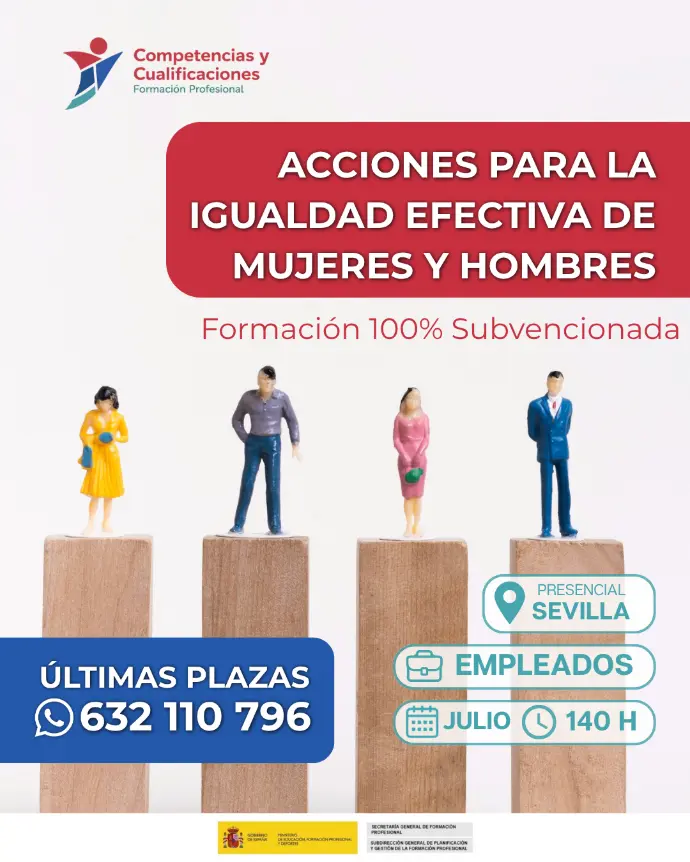
Qualification Level: Level 3.
- Total hours: 140h.
- Date: july.
- Delivery mode: in person in Sevilla.
- Price: 100% funded.
CONTENT
Análisis de la información desde la perspectiva de género.
Gender-Perspective Information Analysis
- Characterization of the patriarchal system and power distribution structures.
- Applying gender as an analytical category / Gender mainstreaming perspective:
- Mechanics of the sex-gender system.
- Definition of gender roles and stereotypes.
- Detection, evaluation, and reporting of sexist stereotypes.
- Mechanisms to detect formal equality versus real (de facto) equality between women and men.
- Identifying types of gender-based discrimination:
- Direct discrimination.
- Indirect discrimination.
- Intersectionality or multiple discrimination.
- Educational mechanisms and their role in gender construction:
- Differentiated gender socialization of boys and girls.
- Mixed-gender education and coeducation (coeducación).
- Key information sources for initial baseline diagnostics on discrimination and violence against women:
- Primary and secondary data identification.
- Selection of gender-sensitive quantitative and qualitative data collection techniques.
- Sex-disaggregated data classification; knowledge and application of gender indicators.
- Gender Impact Assessment (GIA).
- Ethical code, confidentiality protection protocols, and Data Protection Act compliance.
Identification and Treatment of Images and Non-Sexist Language Use
- Identifying women's historical invisibilization; detecting sexist imagery and language.
- Analyzing stereotyping in language and imagery and its influence on gender-focused perception.
- The role of mass media in constructing gender paradigms.
- Alternative solutions to counter sexist stereotypes:
- Strategies for non-sexist language usage.
- Strategies for non-sexist imagery usage.
Everyday Spaces of Participation: Identifying Inequalities and Diversity-Sensitive Intervention
- Detecting domains and levels of participation linked to established gender orders:
- Women’s participation in public spheres (economic, labor, community-based, leisure, and quality of life).
- Men’s participation in domestic spheres.
- Distinction between public, domestic, and private spheres:
- Work-life balance (conciliación) and co-responsibility (corresponsabilidad).
- Formal versus informal space usage by women and men.
- Balanced gender representation (representación paritaria) and quota systems.
- Detection mechanisms for practical gender needs and strategic gender interests within groups.
- Access to and control over resources.
- Gender analysis of roles and task allocation.
- Identifying female diversity within the intervention environment.
- Intervention mechanisms across project design, implementation, monitoring, and evaluation, in coordination with gender equality specialist teams.
Historical Participation of Women: Empowerment Processes
- Overview of women's history and the evolution of feminism:
- Clarifying core misconceptions around feminism.
- Identifying the "glass ceiling" (techo de cristal) in the public sphere.
- Women's empowerment frameworks and processes.
- Tools for equality promotion in coordination with gender specialist teams:
- Positive actions (acciones positivas); Gender Mainstreaming.
- The dual strategy (estrategia dual).
- Gender-responsive budgeting (GRB).
- Resource management in gender equality:
- Mapping institutions and key social stakeholders within intervention contexts.
- Mapping official Equality Bodies (Organismos de Igualdad).
- Locating and developing resources for gender equality, empowerment, and gender-based violence prevention.
- Utilizing ICTs to foster equality and cooperative work.
Structural Elements for Gender Equality in the Workplace
- Application of the sexual division of labor concept.
- Work definition and distinction between productive and reproductive labor.
- Women's consolidation in the Spanish workforce: historical overview and key union, business, and associative figures.
- Women’s participation and representation on corporate boards and governing bodies.
- Identifying priority target groups of women facing special employment barriers:
- Specialized support systems.
- Applicable regulatory and legal frameworks.
- Integrating a gender perspective into job search guidance and career counseling.
Structural Factors Determining Gender-Based Violence
- Features of the patriarchal system contributing to violence against women.
- Typologies of gender-based violence:
- Male violence (violencia machista).
- Domestic violence (violencia doméstica).
- Human trafficking (tráfico).
- Trafficking for sexual exploitation (trata).
- Prostitution.
- Sexual harassment and gender-based harassment (acoso sexual y por razón de sexo).
- Rape.
- Female Genital Mutilation (FGM).
- Assessing the primary impacts and consequences of gender-based violence.
Gender-Perspective Observational Methodologies Across Key Contexts
- Observational mechanisms to track space usage and participation time allocation for women and men:
- Public space vs. private space dynamics.
- Quantity, quality, and substantive content of discretionary time.
- Primary gender-sensitive indicators.
- Applying gender perspectives to Quality of Life (QoL) concepts.
- Procedures for defining, deploying, and evaluating key indicator sets:
- Public welfare and subjective well-being indicators.
- Women’s healthcare quality indicators.
- Sports participation and gender-inclusive urban planning metrics.
- Gender indicators for work-life balance and personal/family life reconciliation.
- Procedures for identifying local gender gaps across intervention environments.
Resource Identification and Management for Effective Gender Equality
- Resource mapping procedures across health, education, leisure, sports, mobility, urbanism, reconciliation, and time management:
- Specialized women's healthcare services.
- Personal autonomy and health support services.
- Sexual and reproductive health clinics and family planning centers.
- Inclusive leisure and recreation programs.
- Grants and subsidies for leisure, cultural, and sports activities.
- Key institutions and services supporting work-life reconciliation and co-responsibility.
- Application of European, national, regional, and local legal frameworks, guides, and manuals across:
- Sexual and reproductive health.
- Public health.
- Leisure and culture.
- Sports and health.
- Inclusive mobility and urbanism.
- Work-life balance, family reconciliation, and time management.
- Quality-of-life improvement policies.
- Utilization of resources from the Women's Health Observatory (Observatorio de Salud de las Mujeres) under the Ministry of Health, Social Services, and Equality.
- Quality Plan of the National Health System (Plan de Calidad del SNS).
- Sectoral reports on gender and health.
- Stakeholder profiling of associations and civic networks focused on health, education, sports, mobility, urban planning, and time-use management with a gender lens.
- Designing awareness-raising and communication campaigns regarding:
- Physical, psychological, emotional, reproductive, and sexual health needs of local women.
- Women’s participation in sports and athletics.
- Women’s participation spaces and time availability.
- Differential health outcomes through a gender perspective.
Awareness and Information Initiatives on Unpaid Domestic and Care Work
- Assessing the economic and social impact of unpaid domestic labor on personal, family, and macro-socioeconomic structures.
- Identifying task chains and spatio-temporal dynamics in caregiving.
- Strategies for transforming time-use patterns among women and men.
- Implementing tools and measures to foster co-responsibility.
- Actionable procedures designed to ease the logistical demands of daily life.
Gender-Sensitive Interventions Across Key Sectors
- Applying biopsychosocial and gender-sensitive definitions of health.
- Observational workflows for women's holistic health (physical, psychological, social, emotional) and differential health profiles.
- Analytical methods for sexual and reproductive health within local intervention zones.
- Protecting and promoting sexual and reproductive rights.
- Applying World Health Organization (WHO) frameworks on gender-role conflicts and health outcomes.
- Mainstreaming gender perspectives into urban planning sectors:
- Public transit and mobility systems.
- Public space design, urban safety, and perception of security.
- Inclusive housing policy.
- Local economic activity and commerce.
- Community facilities, commercial areas, and leisure spaces.
- Executing context-tailored gender equality projects based on specific local needs.